

Learning Is Natural, Schooling Is Optional
Thoughts about homeschooling, employment, and school reform

I spoke at the Maine Home Education Alliance conference on May 2; it was a very well-organized and family-friendly event. One of the sponsors of the conference was General Dynamics/Bath Iron Works, a major company that designs, builds, and maintains ships for the US Navy. They had a popular exhibit that featured hands-on activities, such as building ships that can withstand heavy weight or rough seas in the large water tanks they provided, radio controlled vehicles to drive, 3D pens for making models and sculptures, and friendly, helpful staff members.
A representative from General Dynamics spoke before my speech and she noted how the homeschoolers they hire are team players, take initiative, and are problem solvers, which are the traits the company seeks in its employees and why they support the homeschooling conference. Fortunately for me, that theme was also part of my speech that followed, Learning is Natural, Schooling is Optional. I said:
The pressure we adults put on children to do well in school in order to be successful adults is taking its toll. All the hours of testing, enrichment, extra curricular, and tutoring programs are making children less social, more competitive, and depressed. Meanwhile, the world of work we expect them to join is changing much quicker than the schools are.
Not all businesses require specific degrees for jobs, but you’d never guess that from the pressure educators cause by linking diplomas to employment opportunities. The world is changing rapidly, especially the world of work.
I then showed a slide of the March 2026 issue of Education Week. The headline and copy proclaim:
We asked executives what skills young workers are missing
Students need to learn how to solve problems, manage conflict, and be curious.
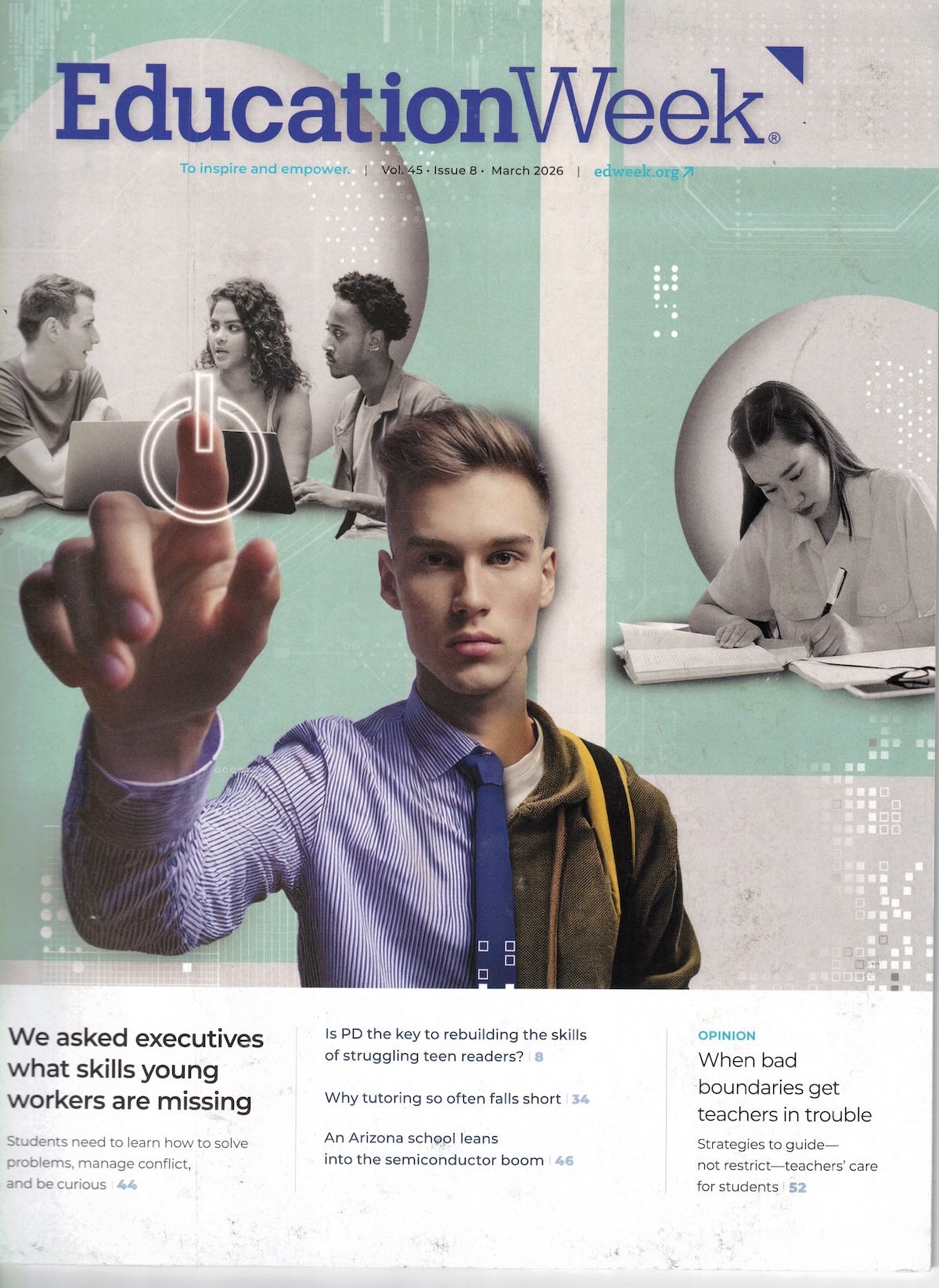
There are many ways to solve problems, manage conflict, and be curious but the schools we have are not providing these experiences to students in meaningful ways. The intensity of schooling and our compliance to fill our children’s lives with more instruction, tests, and tutoring than previous generations of students ever had is not giving us the results educators promised.
Yet, old habits die hard: most businesses still rely on a college degree to separate the wheat from the chafe among potential hires. A recent Gallup poll notes:
While confidence in the value of a degree or credential remains strong among adults without a degree, alumni and employers alike, perceptions of access to a quality, affordable education have fallen to their lowest point in years. … 82% of student loan borrowers are moderately or very worried about struggling to repay their loans.
The situation of going into deep debt for one’s schooling may ultimately be what forces school to change its ways.
Another important factor that should make schools change is the often researched but rarely discussed issue that graduating from school or college doesn’t predict future job performance. For instance:
Hunter, J. E., & Hunter, R. F. (1984). Validity and utility of alternative predictors of job performance. Psychological Bulletin, 96(1), 72–98. This is a large meta‑analysis showing that general ability predicts job performance much more strongly than simple measures such as years of education.
Dr. Lauren Resnick,University of Pittsburgh (1987). In her last speech as president of the American Education Research Association, Learning: In School and Out, she claims: “Growing evidence … points to the possibility that very little can be transported directly from school to out-of-school use.”
Schmidt & Hunter (1998). “The Validity and Utility of Selection Methods in Personnel Psychology” (Psychological Bulletin) shows General Mental Ability (GMA) and work‑sample tests are among the best predictors; ‘years of education’ is among the weakest single predictors.”
Blume, B. D., Ford, J. K., Baldwin, T. T., & Huang, J. L. (2010). “Transfer of training: A meta‑analytic review.” (Personnel Psychology). This meta-analysis shows how learning in classroom or training situations can improve practiced tasks (called “near transfer”) but provide little evidence for broad, durable transfer to general cognition or real‑world skills (“far transfer”).
Educators and policy makers should seriously consider this research and the reality outside of the academic bubble to make schooling adjust to the children and world we live in now. Not everyone can or wants to homeschool, but if schools do not unschool themselves and become open to other modes of learning and teaching they will continue to lose support from the increasing number of families seeking alternatives to conventional school. As the cost of attending school mounts for children and families—mentally, emotionally and financially—alternatives to school are becoming more accepted in society and homeschooling is leading the way.
I too appreciate your work, Pat, and along with The Intuitive Learner below, consider all who are free of the schooling prison should also get free of the larger Statist penitentiary and understand why they should identify with Voluntaryism, here https://voluntaryist.com/ and understand the truth of Voluntaryist scholar Robert Higgs’ warning:
“The beginning of political wisdom is the realization that despite everything you’ve always been taught, the government is not really on your side; indeed, it is out to get you. The mass belief in the general beneficence of democracy represents a kind of Stockholm syndrome writ large. We shall never have real, lasting peace so long as we give our allegiance to the whole conglomeration of institutionalized exploiters and murderers we know as the state.”
I appreciate your work, Pat. However, what’s the point of unschooling if it still results in participating in an economy that centers the military industrial complex? For me, unschooling is not just about better education in the sense that they will get better jobs in the old system. It is about living into a new system that centers sovereignty and heart.